
The Key Takeaway
Proportional targets are a reasonable way to begin collecting adjustment ideas but they should not be the entire strategy. Equal percentages do not create equal educational effects, equal financial benefits, or equal risks.
The final package should be built by comparing proposals across funds and programs, then selecting the combination that provides sufficient recurring General Fund relief with the least damage to students, enrollment, and the district’s long-term direction.
The goal should not be for every department to hit its number. The goal should be for the district to solve the right financial problem responsibly.
South Washington County Schools is asking programs across the district to identify adjustments toward an approximately $13 million target.
The initial targets have been distributed largely according to each program’s share of the budget. If an area represents a larger share of district spending, it receives a larger share of the adjustment target. Here are the adjustment targets by program area for the one-year adjustment to be approved by the board in November 2026:
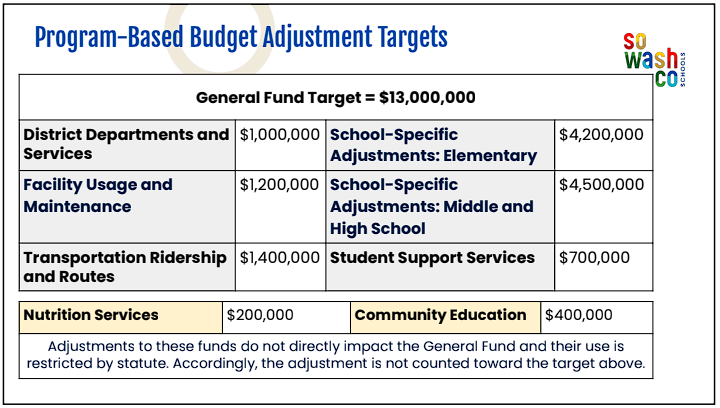
Source: South Washington County Schools, Budget Adjustment Update presentation dated July 16, 2026.
That approach has an understandable appeal.
It gives every department a number. It spreads responsibility across the organization. It avoids beginning the process by declaring particular programs protected or expendable.
As a way to generate options, proportional targets may be useful.
But a mathematical allocation should not determine the final adjustment package.
Programs differ in their financial condition, legal restrictions, existing capacity, student impact, revenue effects, and ability to reduce costs. Applying the same percentage everywhere can appear fair while producing very different consequences.
The final package should be selected by comparing proposals across the district, not by requiring every program to meet its assigned number independently.
How Proportional Targets Work
Suppose a program represents 10% of the budget being reviewed.
Under a proportional approach, that program might receive approximately 10% of the total adjustment target.
If the district needs $13 million in adjustments, each area is asked to contribute according to its relative size.
This provides a simple starting point. It does not answer the more important questions:
- Which costs are actually contributing to the General Fund deficit?
- Which reductions produce recurring savings?
- Which programs are already operating at or beyond capacity?
- Which money is legally available to address the problem?
- Which changes would most affect students?
- Which programs influence enrollment?
- Which alternatives produce the least long-term harm?
Budget size alone cannot answer those questions.
Equal Percentages Can Produce Unequal Effects
A 3% target does not mean the same thing in every program.
Depending on the area, it could result in:
- Fewer classroom teachers
- Larger class sizes
- Reduced electives
- Fewer extracurricular activities
- Less counseling or student support
- Higher Community Education fees
- Reduced early-childhood access
- Delayed kitchen-equipment replacement
- Fewer administrators
- Deferred facility maintenance
- Reduced transportation service
- Elimination of a small program
The percentage may be equal. The effect on students, families, employees, and district finances is not.
A large program may be able to absorb a reduction through several smaller operational changes. A small program may have no option other than eliminating an entire service.
A legally required program may have less flexibility than a discretionary one. A fee-supported program may respond by increasing prices, while a classroom program may respond by increasing class size.
Treating those outcomes as equivalent because they satisfy the same percentage target confuses arithmetic consistency with strategic fairness.
Not Every Dollar Solves the Same Problem
As explained in our school-finance series, SoWashCo maintains several separate funds.
Money in the General Fund supports most regular K-12 operations. Other funds support Nutrition Services, Community Education, construction, debt repayment, and post-employment benefits.
Those dollars are not freely interchangeable.
An adjustment that improves the Food Service Fund does not necessarily provide an equal amount of relief to the unrestricted General Fund. A reduction in construction spending cannot ordinarily be redirected to classroom salaries. Community Education revenue may be restricted or connected to fees charged for specific services.
Every program should be reviewed for efficiency. But the district should show how each adjustment contributes to the stated financial objective.
For every proposal, the public should be able to see:
- Which fund is affected
- Whether the adjustment reduces General Fund spending
- Whether it reduces spending in a restricted fund
- Whether it changes revenue
- Whether it shifts costs elsewhere
- Whether the benefit is recurring
- Whether the districtwide financial position actually improves
Without that information, several adjustments can be added together under a single headline even though they do not all solve the same deficit.
Nutrition Services Illustrates the Problem
Nutrition Services is accounted for in the separate Food Service Fund. See our discussion of restricted funds in our Decoding The Budget series.
The program is financially self-sustaining. Its local, state, and federal revenue is sufficient to cover its operating expenses without drawing support from the General Fund.
For 2026-27, the Food Service Fund is projected to:
- Receive approximately $16.4 million
- Spend approximately $16.2 million
- Add approximately $160,000 to fund balance
- End with a balance of approximately $6.3 million
- Maintain a fund balance equal to approximately 38.7% of annual expenditures
That is a healthy financial position. The reserve helps Nutrition Services manage cash flow and systematically replace or upgrade kitchen equipment without relying on regular K-12 instructional funding.
A healthy balance can justify reviewing whether the program’s revenue, reserves, and expenses are appropriately aligned. But adjustments within Nutrition Services cannot directly eliminate the General Fund deficit.
Food Service money is restricted to nutrition-related purposes. Savings produced within the fund generally remain there rather than becoming unrestricted General Fund resources.
The relationship between the two funds also works in the other direction.
Nutrition Services currently reimburses or supports the General Fund for costs associated with its operations, including lunchroom para support. Those payments help offset expenses that would otherwise remain in the General Fund.
That means a Nutrition Services reduction could have several different effects:
- Lower Food Service expenditures
- Increase the Food Service fund balance
- Reduce future equipment needs
- Change meal service or staffing
- Reduce payments supporting General Fund lunch paras
- Shift costs back to the General Fund
- Produce little or no improvement in the unrestricted General Fund deficit
The district should therefore evaluate the net effect across both funds.
If adjustments are warranted, they should preserve the program’s ability to operate independently and continue supporting shared General Fund costs. A reduction that saves money in the Food Service Fund while increasing General Fund expenses would not help solve the district’s stated operating problem.
Nutrition Services should not be exempt from efficiency review. But its target should reflect its actual financial condition, legal restrictions, equipment obligations, and existing support of the General Fund.
The relevant question is not simply how much Nutrition Services can reduce. It is:
After accounting for fund restrictions and the support Nutrition Services provides to the General Fund, how much does the proposed change improve the district’s overall financial position?
Existing Capacity Matters
Programs also differ in their ability to absorb reductions.
The district reports substantial unused elementary building capacity in parts of the system. At the same time, some high schools remain crowded.
Early-childhood programs face access and scheduling constraints. Some families cannot obtain placement or cannot make partial-day programming work.
These conditions should influence the final package.
A reduction in an underused facility may address a structural cost problem. A similar percentage reduction in a crowded high school could increase class sizes, reduce course access, or weaken programs that help retain students.
A reduction in a supply-constrained program may lower service levels without addressing excess capacity.
The district should not assume that every area has the same amount of unused capacity simply because every area has a budget.
Enrollment Effects Matter
Programs are not only expenses. Some help families choose and remain with SoWashCo Schools.
Electives, activities, athletics, language immersion, advanced coursework, career programs, early learning, and student support can influence enrollment decisions.
This does not make those programs immune from review.
It means their financial effect includes more than direct cost.
A proposed reduction may save money while also causing some students to leave. Because state funding follows enrollment, the resulting revenue loss may offset part of the expected saving.
The district should ask:
- Does this program attract or retain students?
- Is the program available from competing districts or charter schools?
- Is demand growing, stable, or declining?
- Would reducing it make SoWashCo less distinctive?
- Has the district estimated the possible enrollment effect?
- How much enrollment loss would offset the proposed savings?
A budget process that ignores enrollment effects may reduce expenses in the short term while weakening revenue over time.
Legal Requirements and Educational Priorities Matter
Some programs exist because federal or state law requires the district to provide them.
Others reflect local educational priorities.
A proportional target does not distinguish between:
- Required and discretionary services
- Core and supplemental programming
- Services with available alternatives and services without them
- Programs already below desired service levels and programs with excess capacity
- Spending that can be reduced immediately and spending tied to contracts or mandates
The final adjustment package should recognize these differences.
That does not mean required programs cannot become more efficient. It means the district must evaluate what flexibility actually exists and what costs would move elsewhere if a service changes.
Departments Should Generate Options, Not Make the Final Tradeoffs
Program leaders understand their own operations better than a central budget team.
It is reasonable to ask each department to identify:
- Efficiencies
- Service-model changes
- Vacancies
- Revenue opportunities
- Lower-priority work
- Risks associated with reductions
But department-by-department target setting creates a structural limitation.
Each leader is asked to find savings within a predefined boundary. They may not be able to say:
We can produce another $200,000 with relatively little effect if it prevents a more harmful $200,000 reduction in another program.
That comparison must occur above the department level.
Senior leadership and the School Board are responsible for reviewing the proposals together and determining which combination best serves the district.
The program targets should open the discussion, not end it.
Overachievement in One Area Should Be Considered Across the District
Suppose one department identifies recurring savings beyond its assigned target with limited service impact.
Another department may be able to meet its target only by eliminating a highly valued service.
A rigid target process could accept both proposals because each department is evaluated independently.
A strategic process would ask whether the lower-impact savings from the first area should replace the higher-impact reduction in the second.
The same principle applies when:
- One proposal affects a restricted fund rather than the General Fund
- One adjustment is temporary while another is recurring
- One change reduces enrollment risk while another increases it
- One program is underused while another is already constrained
- One proposal creates substantial implementation costs
- One reduction limits options needed for the five-year plan
The final package should optimize the districtwide result.
It should not simply total completed departmental assignments.
A Complete Evaluation Framework
Every proposal should be evaluated using the same criteria.
| Criterion | Question |
|---|---|
| General Fund benefit | How much unrestricted General Fund relief does the proposal provide? |
| Recurring value | Does the saving continue in future years? |
| First-year value | How much will actually be saved during implementation? |
| Educational impact | What changes for students? |
| Enrollment impact | Could the change attract or repel families? |
| Current capacity | Is the service underused, balanced, or already constrained? |
| Legal flexibility | Can the affected money address the stated deficit? |
| Revenue effect | Does the proposal reduce fees, enrollment funding, or other income? |
| Cost shifting | Does the expense move to another department, fund, or future year? |
| Implementation risk | Can the saving be achieved on schedule? |
| Strategic alignment | Does it support the district’s five-year direction? |
| Reversibility | Can the decision be corrected if assumptions change? |
The district does not need to reduce every proposal to one numerical score.
It should use a consistent framework so decision-makers and the public can understand the tradeoffs.
The Final Package Must Be Tested for Sufficiency
After individual proposals are selected, the district should return to the financial forecast.
The final package should show:
- Total first-year savings
- Total recurring savings
- General Fund savings
- Savings in other funds
- Revenue changes
- Implementation costs
- Remaining annual deficit
- Projected fund balance
- Progress toward the 16.6% Policy 701.2 benchmark
- Financial work left for the five-year plan
A package can meet a $13 million headline target and still fail to stabilize the General Fund if some adjustments are temporary, restricted, delayed, or offset by revenue losses.
The total must be tested against the problem it is intended to solve.
What the School Board Should Ask
Before approving the package, School Board members should ask:
- Which proposals provide recurring unrestricted General Fund savings?
- Which proposals affect only restricted or separate funds?
- Which services are already operating at capacity?
- Which programs may influence enrollment?
- What costs are deferred or shifted elsewhere?
- Were lower-impact alternatives available in other departments?
- How were cross-program tradeoffs evaluated?
- What happens to class sizes, course offerings, and student support?
- Does the package restore the General Fund balance trajectory?
- What additional action remains for the five-year plan?
These questions do not undermine the work performed by individual departments.
They are the districtwide review required after that work is completed.