
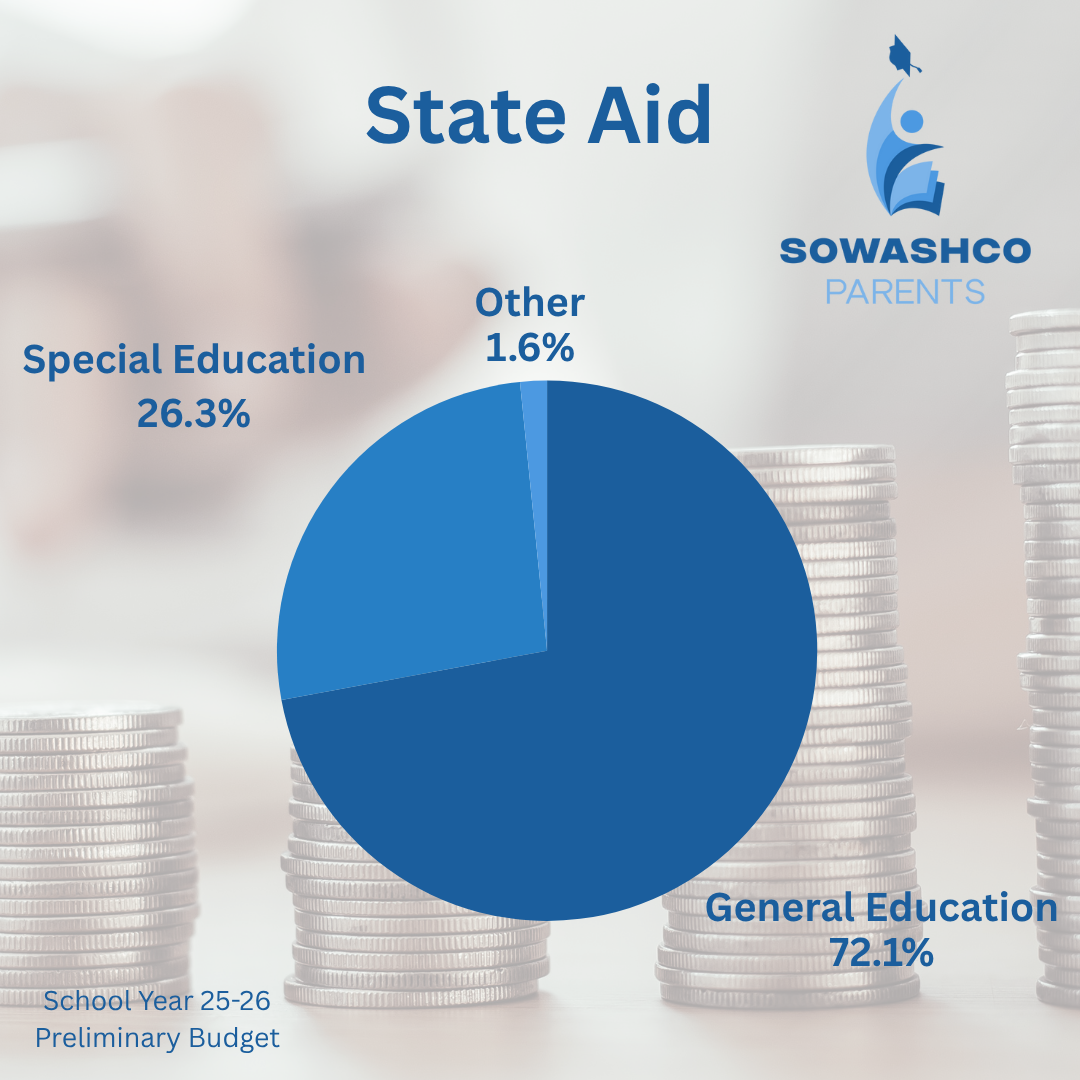
In our 3-part series Decoding The Budget we learned that State Aid is the largest revenue source for the school district. In school year 25-26 State Aid will provide nearly $264M – representing over 60% of all non-construction bonding revenue. But State Aid is complicated and depends on a lot of formulas. Don’t worry – we’ll walk through each of the 7 State Aid funding sources below. You can dive even deeper by clicking on the links in each section:
General Education Aid
General Education Aid is the largest funding source for the school district totaling $174M in school year 25-26, and unsurprisingly has a lot of complicated formulas. Click here to dive deeper. The Minnesota Constitution requires that the legislature provide for “uniform” education across the state. The state recognizes that school districts may need more or less money per student based on unique characteristics of the district. For example, rural school districts need more transportation funding per student because students live further apart. Districts with more students not proficient in English need more funding to help students learn English.
Special Education Aid
The district receives nearly $64M (school year 25-26) to help fund the additional costs associated with providing required services to students with disabilities. This year the district serves over 4,000 students with disabilities.
Permanent School Fund
In the mid-1800’s, lands were granted to the State by the Federal government and were placed in a trust fund called the Permanent School Fund. The State constitution requires that any revenue generated (from timber, mining, or sale of land) be held in this trust. Any interest earnings must be distributed to school districts based on the number of students served. The district receives $1.3M in school year 25-26 from this fund.
Non-Pupil Transportation Aid
Charter schools can require that the public school district they are located in provide transportation for charter school students to the charter school. The state helps offset a portion of this cost, though the district must find other revenue to cover any shortfall. The district receives $0.90M in school year 25-26 for this purpose.
Literacy Incentive Aid
The district receives about $0.98M (school year 25-26) to help students achieve proficiency and growth in reading. This is determined based on student performance on the 3rd grade and 4th grade Minnesota Comprehensive Assessment tests.
Student Support Personnel
The district receives $0.36M (school year 25-26) specifically to fund school counselors, psychologists, social workers, nurses, and/or chemical dependency counselors.
School Library Aid
The district receives $0.34M (school year 25-26) specifically to fund libraries and library staff.